 Remember, my dears, that the festival of the Exaltation of the Holy Cross this year is also the 30th anniversary of the untimely death of Her Serene Highness, the Princess Grace Kelly of Monaco. Put it into your diaries! I hope to make a personal pilgrimage to Monaco to pray by her tomb in the cathedral.
Tuesday, 10 April 2012
14th September A.D 2012...
Remember, my dears, that the festival of the Exaltation of the Holy Cross this year is also the 30th anniversary of the untimely death of Her Serene Highness, the Princess Grace Kelly of Monaco. Put it into your diaries! I hope to make a personal pilgrimage to Monaco to pray by her tomb in the cathedral.
Monday, 9 April 2012
In Spirit and Truth...

May my words and our thoughts be in the Name of God.
Being in communion with no church is rather difficult when Holy Week comes around, although this does sometimes have some benefits. In my experience, being ''attached'' to a particular church often means that you have to put up with some rubbish, at the will of the celebrant, for ''political'' (or pastoral) reasons, or whatever. Although not being attached also means that I cannot order all things as I would. Signum Magnum and St Joseph (Stalin) the Working Class Blaggard of the Communist Party spring to mind, not to mention other mainstream churches cutting out huge chunks because the celebrant may feel they are too long. I am not a diplomatic person, and my only conceivable response to all this rubbish is to withdraw my support completely, and depart shaking the dust from my feet. Why should God-fearing Christians have to put up with inauthentic Divine Service, the structure thereof being decided beforehand by the priest in charge? It's just parish committee Liturgy, in the manner of the Roman reforms of the 20th century, except at local level. Sins against the Holy Ghost, I daresay.
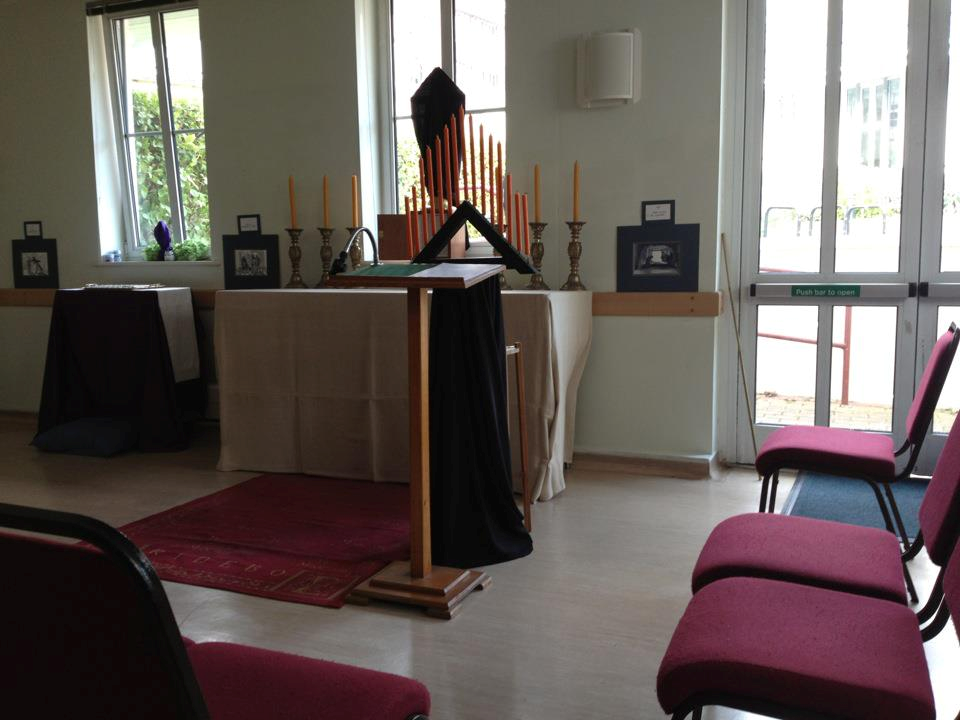
The sanctuary prepared for Tenebrae in Parasceve. Don't panic! The rug was taken away before the service commenced.
I said in my previous post that I had a modest part in a quiet Triduum somewhere. On Spy Wednesday evening my friend and I monotoned the offices of Mattins & Lauds according to the special form for the Triduum (Tenebrae) in the house chapel. On the morning of Maundy Thursday my fellow churchmen and I celebrated Mass of the Lord's Supper and had prayers at the altar of repose before lunch. At five o'clock Tenebrae in Parasceve was sung. On Good Friday morning we monotoned the Hours of Prime, Terce, Sext and None before offering up to God the Mass of the Pre-Hallowed Gifts. I was privileged to offer a Rood of much personal sentimental value for use for veneration on Good Friday (pictured at the top of this post) - a Spanish crucifix saved by my grandmother from a Philistine about 40 years ago. It was solemnly ''blessed'' according to the old form in the Ritual by a man whose orders are null and utterly void three years ago, so I am going to have it blessed again. Anyway, I made sure to pray for the perfidious pope (I sat down for this), that the Lord would see it fitting to rain down fire from Heaven on this great pretender, and wielder of false apostolic authority. We were (thankfully) excused from ''stations of the Cross'' this year, but returned to sing Tenebrae at five o'clock. On Holy Saturday morning we sang the Hours of Prime, Terce, Sext and None before processing outside to bless the New Fire and celebrate the Paschal Vigil and celebrate Vesperal Liturgy. The deacon substituted devotissimum Imperatorem nostrum in the Exultet for devotissimam Reginam nostram Elizabeth, which was good. She is, after all, Defender of the Faith and our gracious Sovereign. Who was it that said that the ''Holy Roman Empire'' was in no wise ''holy,'' ''Roman,'' nor an ''empire'' in the proper sense?

This is me about to burn an insult to Catholic order; an insert from a 1925 Missale Romanum.
UPDATE: On the evening of Holy Saturday, that solemn and serious Day on which the Lord preached to the souls in prison, my friend and I said Paschal Mattins & Lauds, which, as Rubricarius has said, was, in Mediaeval times, the highlight of Paschaltide and the most important service of the Christian Year. I received a text message this morning from my friend who told me that I forgot to mention it, fortunately not after the manner of those who ''forgot'' to include it in their parish schedule for Holy Week services. It's really rather short, and I can't understand why people make the effort for Tenebrae and not Paschal Mattins & Lauds, which is more important. It's enough for me to admonish non-Christians to avoid going to church at all, since most Christians simply can't be bothered.
We had no real difficulties this year. At several points we were relying on the 1731 Memoriale Rituum, and therefore incensation proved difficult on Holy Saturday. At the Magnificat no incense was offered at all (this was my fault), but you understand the difficulty of dividing the jobs of about fifteen people between two servers, and the Memoriale does not conceive of incense at this point. We are only men, and the only perfect Liturgy is offered in the immediate presence of God in Heaven. It was, nonetheless, a worthy and memorable Triduum.

That the abomination may be burned out of the heart of Christ's Church!
Being so deeply involved in the ceremonies meant that few photos were taken. There's always next year. It will all be solemn next year as we will have two deacons, with me responsible for everything else. I can't wait!

My lemon, Paschal socks.
Sunday, 8 April 2012
Just a quick post...

...to wish you all a very holy and joyful Pascha. I was again very busy, and all mistakes made during the solemn and serious ceremonies of the Triduum were my own fault, but I account myself blessed to have had a small part in so great a mystery, even if I have fallen somewhat from the ''right,'' (if one could call it that) to serve at God's holy altar. It has been very humbling for me.
I'm sorry I had nothing scheduled to compensate for my absence (save on Goode Fryday), but I expect you all know how it is, even those of you unfortunate enough to be ''without Tradition,'' as I have heard it said. I was going to say something about the absolute necessity of Twelve Prophecies for the Paschal Vigil; how each in their turn narrates the history of Salvation, from Creation unto Redemption (in the Epistle and Gospel of the Vesperal Liturgy), but maybe next year. This itself puts us at a serious disadvantage, since one year my churchmen and I hope to do Sarum (which has only four prophecies for the Vigil). Anyway, enough rambling from me. Enjoy the Feast!
Haec dies quam fecit Dominus: exultemus et laetemur in ea, Alleluia!
Friday, 6 April 2012
In Goode Fryday...
 Who hath believed our report? and to whom is the arm of the Lord revealed?
For he shall grow up before him as a tender plant, and as a root out of a dry ground: he hath no form nor comeliness; and when we shall see him, there is no beauty that we should desire him.
He is despised and rejected of men; a man of sorrows, and acquainted with grief: and we hid as it were our faces from him; he was despised, and we esteemed him not.
Surely he hath borne our griefs, and carried our sorrows: yet we did esteem him stricken, smitten of God, and afflicted.
But he was wounded for our transgressions, he was bruised for our iniquities: the chastisement of our peace was upon him; and with his stripes we are healed.
All we like sheep have gone astray; we have turned every one to his own way; and the Lord hath laid on him the iniquity of us all.
He was oppressed, and he was afflicted, yet he opened not his mouth: he is brought as a lamb to the slaughter, and as a sheep before her shearers is dumb, so he openeth not his mouth.
He was taken from prison and from judgement: and who shall declare his generation? for he was cut off out of the land of the living: for the transgression of my people was he stricken.
And he made his grave with the wicked, and with the rich in his death; because he had done no violence, neither was any deceit in his mouth.
Yet it pleased the Lord to bruise him; he hath put him to grief: when thou shalt make his soul an offering for sin, he shall see his seed, he shall prolong his days, and the pleasure of the Lord shall prosper in his hand.
He shall see of the travail of his soul, and shall be satisfied: by his knowledge shall my righteous servant justify many; for he shall bear their iniquities.
Therefore will I divide him a portion with the great, and he shall divide the spoil with the strong; because he hath poured out his soul unto death: and he was numbered with the transgressors; and he bare the sin of many, and made intercession for the transgressors.
Isaias, Caput LIII.
Sunday, 1 April 2012
Palm Sunday...
 Holy Week is upon us once more, and again my diary is full. From Spy Wednesday even unto Easter Even my fellow churchmen and I shall be following the Old Roman Rite to the letter. I'd rather be doing Sarum, of course, but on the positive side - if we didn't do it, who the hell would?
I am at this very moment travelling many miles out of my way for a celebration of traditional Palm Sunday. I could, of course, walk the 17 minutes down hill to Blackfen for what purports to be a ''high Mass'' with folded chasubles, but since they claim to be implementing Summorum Pontificum (are folded chasubles allowed by Summorum Pontificum?), and that I was thrust from the sacristy like an unclean thing last year, I think I shall be staying away from that place. Oh well. I did remember to shake the dust from my feet as I departed, in token of the wrath to come.
On that thought, I wish you all the best for Holy Week!
Saturday, 31 March 2012
Let's have another Mass!

The New Liturgical Movement had a rare, interesting post the other day; a quote, in fact, by the great Dr John Wickham-Legg, one of the 19th century's great scholars of historical liturgy and whose predictions about the later twentieth century liturgical reforms at the behest of the popes of Rome proved accurate, very accurate indeed. The quote is about low Mass, or Missa Privata, a purely Western phenomenon, and which I consider a liturgical abuse of the worst kind - akin to celebration with one's back to the East, the direction of Jerusalem, and from whence Christ will come on the Last Day, even unto the West, to judge both the quick and the dead. Dr Wickham-Legg writes even so:
The variations in the ceremonies practiced in the celebration of the Eucharist make a division into two heads easy: missa solemnis and missa privata. The missa solemnis is the public, or high Mass, and gives us the rule for the celebration of the Eucharist. The priest is assisted by a deacon and subdeacon....The private, or low Mass, on the other hand, must be regarded as the exception, and in this the priest is assisted by a server only. It is the presence of the deacon and subdeacon which makes the difference between high Mass and private Mass, and not whether any part of the service be sung. Now, it cannot be too often repeated that it is only high Mass which gives us the ancient, typical ceremonies of the celebration of the Eucharist, and from which we may learn the true idea of the Eucharistic rites. Low Mass only gives us the rite in a maimed and imperfect, not to say corrupt and irregular way. Private, or low Mass, that is, a celebration of the Eucharist without deacon or subdeacon, was as little known to the Church at large for the first 800 years, as it is to this day to the Eastern Church. It seems to have come in when Latin ceased to be understood by the people, who betook themselves, therefore, to their private prayers. Low Mass robbed the medieval church of the idea of common prayer, which it is the glory of our Prayer Book to have brought back. The celebration of the Eucharist in private (I am only using the word still used by the Roman Missal) shews but small respect to the Christian mysteries. It may be borne with in country parishes where there is no one in holy orders but the curate himself, but to see in a church with a large staff the altar served by some boy taken out of the street, who probably does not know his Catechism, and has not been confirmed, while men in holy orders are doing nothing in the stalls of the choir, or only come into church to distribute the Communion, shews that there is little or no zeal for the solemnity of the Eucharist. It shews a contempt for the practices of antiquity, to which in all questions of ceremonial, as well as in faith and morals, the Church of England appeals.... Even the more learned Roman Catholic authorities dislike the boy server, and tell us that it is the deacon who is the proper minister of the altar.
''On Some Ancient Liturgical Customs Now Falling Into Disuse,'' in Transactions of the St Paul’s Ecclesiological Society, vol. 2 (London, 1890), 123-24.
Another example of Anglican patrimony, I daresay, which Rome has lately claimed to admire and esteem, when just a century ago it could not be borne - are not Anglican orders, for example, null and utterly void in the eyes of Rome? Naturally I agree with everything Dr Wickham-Legg says, especially about the sense of corporate worship and that low Mass renders the Eucharistic liturgy bare of all dignity and splendour. Many who knew me in my days as a Roman Catholic (and a ''traditionalist'') will probably think that I have been too easily influenced by men like Dr Wickham-Legg and Percy Dearmer. I can actually say in all honesty, however, that I arrived at my conclusions about low Mass on my own. Initially it's because I found it boring and uninspiring; and it is, objectively. People who like low Mass are ill-informed and ought to be educated. Low Mass is for people who simply can't be bothered with Divine Service, and the same goes for people who disdain the Divine Offices.
The comment thread on the NLM post is interesting, and demonstrates two things - the disdain Roman Catholics have for great champions of Anglican patrimony (and, by extension, the Anglican patrimony itself - which proves that the Ordinariate is just a sham), and the typical Roman response to any criticism of their system. Let it be said that you may question the conclusions of Dr Wickham-Legg in matters liturgical when his conclusions are proven to be false, or without warrant.
Friday, 30 March 2012
Apologies...
I'm afraid there was an ''incident'' with two of my email accounts and I have lost everything. Could the reader who expressed an interest in my books kindly send me their details again so that I can arrange for the books to be sent?
Many thanks.
Many thanks.
Wednesday, 28 March 2012
40 years ago today...

On this day, the 28th March in the Year of our Lord 1972, J.R.R Tolkien, by now a highly decorated and accomplished octogenarian, received his CBE medal from our Sovereign Lady Queen Elizabeth II at Buckingham Palace for services to English Literature, an occasion, he wrote letter, which he found both memorable and delightful. As arranged by Rayner Unwin, a car collected Tolkien, Fr John and Priscilla (Edith had died the year before) from Brown's Hotel at 9.45am and drove them to Buckingham Palace where, he wrote later, ''inside...the ceremonies were, especially for recipients, accompanied by some tedium (with a few touches of the comic). But I was very deeply moved by my brief meeting with the Queen, & our few words together. Quite unlike anything that I had expected.'' (The Letters of J.R.R Tolkien, no.334).
Blessed John Tolkien, pray for us.
O Lord, save the Queen.
Monday, 26 March 2012
Mgr Gilbey...

The great Mgr Alfred Gilbey died 14 years ago today. Customers of the St Lawrence Press Ordo will notice that on 26th March, under the instructions for the liturgical day, is written: Dies Anniv Rmi Alfredi Newman Canonici Gilbey, Praelati, 1998. This inclusion is due to the fact that Mgr Gilbey bought, and used, the Ordo. I have heard nothing but praise of Mgr Gilbey from those who knew him well (including many of my personal friends). Great among the proto-Traditionalists of the Church, he resigned from the Chaplaincy to Fisher House, Cambridge in 1965, after 33 years, when it became clear that the university would admit women to the status of undergraduates - a man whose views about women resemble my own. It can be said that the shibboleth of Liturgiae Causa is the pseudo-feast of ''Joseph the Worker,'' about which I have written at length before. Mgr Gilbey, who was herald of a time when traditionalism was about at least the semblance of Tradition, had nothing to do with it, and on 1st May was wont to come from the sacristy of the London Oratory in a chasuble of the blood red hue of the Martyrs, to the indignation of the provost. Nor did he ever say the Collect Pro Papa on the days prescribed, but said rather Ecclesiae. Modern Traddies conveniently seem to forget this.
Were Mgr Gilbey alive to-day, I doubt he would identify with modern day traditionalists and their reprobate customs. Mgr Gilbey was a gentleman with principles and sense, not a sell out to the Ultramontane Papacy. I wonder if Tolkien knew him? It seems not unlikely. I expect they had a great deal in common.
Were Mgr Gilbey alive to-day, I doubt he would identify with modern day traditionalists and their reprobate customs. Mgr Gilbey was a gentleman with principles and sense, not a sell out to the Ultramontane Papacy. I wonder if Tolkien knew him? It seems not unlikely. I expect they had a great deal in common.
I couldn't find a photo of Mgr Gilbey, so this image of the Travellers Club will have to do, I'm afraid. Mgr Gilbey did, of course, take up permanent residence there when he retired.
Requiescat in pace.
Requiescat in pace.
Lady Day...

''And God saw all the things which he had made, and they were full good. And the eventide and the morrowtide was made, the sixth day.'' Genesis 1:31.
''And the angel said to her, Dread thou not, Mary, for thou hast found grace with God. Lo! thou shalt conceive in the womb, and shalt bear a son, and thou shalt call his name Jesus.'' St Luke 1:30-31.
''But one of the soldiers, with a spear, pierced his side, and forthwith came thereout blood and water. And he that saw it bare record, and his record is true: and he knoweth that he saith true, that ye might believe. For these things were done that the Scriptures should be fulfilled, A bone of him shall not be broken. And again, another Scripture saith, They shall look on him whom they pierced.'' St John 19:34-37.
A very happy feast to you all, and indeed a Happy New Year! In Catholic England, until 1752, the new year, logically, started in the Spring of the Year nigh to the Equinox, upon the festival of St Mary's Annunciation.
My hero, J.R.R Tolkien, was a Catholic and a mediaevalist, and in the tradition of the Saxons it came to pass, by Divine ordinance, that the Dark Lord Sauron fell on 25th March. Quoth Gandalf:
''But in Gondor the New Year will always now begin upon the twenty-fifth of March when Sauron fell, and when you were brought out of the fire to the King.'' The Lord of the Rings, Book VI, Chapter IV.

The Saxons believed, as indeed it was held in ancient tradition throughout mediaeval Europe, that Lady Day was also that solemn and serious Day upon which Our Lord was crucified, and the last day of Creation - a Day most holy, and encapsulating a treblefold mystery of our Redemption. All of this is asserted in Byrhtferth's Manual, written by Byrhtnerth, a monk of Ramsey, c. A.D 970-c.1020. Until the adoption of the Gregorian Kalendar in 1752, the 25th March was the beginning of the new year for most legal and official purposes in England, and a remnant of that still exists today, with the fiscal cycle. The Fellowship of the Ring departed from Rivendell on 25th December, and the realm of Sauron was ended on the 25th March. You see, it is not just in the Marian symbolism implicit in such persons as Elbereth and Galadriel, or Catholic teaching about death in the confusion of immortality with limitless serial longevity in the Athrabeth Finrod ah Andreth, or the symbolism of Aragorn as a new ''Holy Roman Emperor,'' in which we read aright the faith of the holy Fathers, but in the moral and religious significance of dates also. In other words, it is behoveful as Catholics to keep New Year on its right and proper day.
Roman Catholic Traditionalists, of course, with their typical rejection of anything old (or in this case, ancestrally Christian!), will continue to celebrate the new year on 1st January. God forbid that we remember anything which hath not its uttermost source in the pope!
Sancta Maria, ora pro nobis.
Friday, 23 March 2012
Just for the record...
I am not now, nor will I ever be, a communicating member of the Church of England. That church, the only legitimate claimant of catholicity in the land, being by law established, has deliberately abandoned the Catholic faith - by laying hands on women. Not that the Roman communion has any right to have churches or diocese' in England (or even members), but that is another matter.
Wednesday, 21 March 2012
Thomas Cranmer...

Today is the anniversary of the martyrdom of Thomas Cranmer, one of the Oxford Martyrs, who was burned at the stake for treason and heresy under our late Sovereign Queen Mary I. Cranmer was a masterful man and an eminent scholar, whose enduring legacy is the Prayer Book of the Church of England, although it is unclear how much of the same was his own composition. It is established that he was influenced in the structure of Mattins and Evensong by the Quiñones breviary (which was, thank God, abolished in 1568), the Holy Communion by the Sarum Missal, Luther's Deutsche Messe and Litany, etc. In all fairness, we can't really say much for Cranmer's moral character, having married secretly whilst in Orders, all those recantations made out of fear, not to mention his unfair treatment of the reformer John Frith in 1533, etc, but it would be a great disservice to the great man to say, as so many Romish biographers have, that he was an opportunist and a sycophant, without principle or conviction. His heroic stand at the University Church of St Mary the Virgin on 18th March was commendable, where he said: ''And as for the pope, I refuse him, as Christ's enemy, and Antichrist with all his false doctrine!'' Pure Patrimony! Therewith he was dragged from the pulpit and imprisoned, to be put to death a few days later. He died, his right hand, with which he had written his recantations, outstretched to receive the flames.

Cranmer did much to extend and unify the English language in the realm, a feat comparable to the influence of Dante on Mediaeval Italian. The 1549 Prayer Book Rebellion was due in part to the fact that Cranmerian English was little understood in the West Country, and a translation of the Prayer Book into Cornish was never made (this can actually be cited in favour of the liturgical use of Latin, at least as a unifying principle). At any rate, the subsequent Demands of the Western Rebels shews how much the minds of men were still under the yoke of superstition. An example of Cranmer's masterful, beauteous English can be taken from the Eucharistic Prayer of the 1549 Prayer Book:
And, here we do give unto thee most high praise and hearty thanks, for the wonderful grace and virtue declared in all thy Saints from the beginning of the world: And chiefly in the glorious and most Blessed Virgin Mary, Mother of thy Son, Jesus Christ, Our Lord and God, and in the holy Patriarchs, Prophets, Apostles and Martyrs, whose examples and steadfastness in thy faith, and keeping thy holy commandments, grant us to follow.
Does anyone know if Cranmer has a place in the Ordinariate kalendar of saints days?! To have created and influenced so great a part of the Anglican Patrimony for four hundred years, I would have thought he would merit something - a proper Collect, Epistle and Gospel, at least?
Subscribe to:
Posts (Atom)