Tuesday, 25 December 2012

The Nutcracker...


Someone suggested to me the other day that depression can inspire some of the greatest art known to man. It's true but at the time I could only think of Van Gogh and his Starry Night, famous for its swirls of intense colour upon a deep blue sky - forsooth the work of a mind in great travail. Van Gogh was not a great artist (in my opinion) but The Starry Night is a work of art, albeit one which I would not like to see before retiring.

On Friday I am going to see The Nutcracker at the Royal Opera House, which is a kind of Christmass tradition for me. My grandmother first took me in a time which seems now immeasurably remote, beyond all fateful knowledge of religion, and when hobbits, rings and elves were still new to me. I've often longed for the sensation of that first time, of discovering the works of Tolkien in a secret library somewhere, known only to me, in form as of a mediaeval Book of Hours, with the tales told in a firm, flowing hand in the most beauteous calligraphy and decked about with illustrations in Tolkien's own hand, like this dragon.

Familiarity can make even the most exquisite literature grow stale, and I first knew that something was wrong when I got bored of The Hobbit, upon taking that great work up for to read on the 75th anniversary of its publication. Anyway, coming back to The Nutcracker, which I suppose is the balletic equivalent to a Terry's Chocolate Orange, and it seems a rather puerile work; a huge Christmass tree, a kingdom of sweets and a sugar plum fairy are hardly the stuff of the most noble tradition, are they? But put that impression away which was the impression of Tchaikovsky himself when Petipa gave him the synopsis, and watch so that you can see, and listen so that you can hear. When Tchaikovsky received the commission from the Imperial Mariinsky Theatre he was depressed; sniping critics in St Petersburg, the fact that the Tsar had snubbed his latest opera, the breakdown of his disastrous marriage (well, he was homosexual), and the death of his sister, I expect all had their way with him. But his mood finds expression in the score. The music has many layers, at once lively as the Russian Dance, and melancholy as the famous pas de deux of the Sugar Plum Fairy, which all implicate the state of Tchaikovsky's great and troubled mind. While I am not familiar with Petipa's original choreography the performance at Covent Garden is always rather splendid and I think that together Tchaikovsky and Petipa produced something very sweet (no pun intended) and cheerful for the season.
The original production of The Nutcracker at the Imperial Mariinsky Theatre, St Petersburg, Christmass, 1892.

Monday, 24 December 2012

In cordis iubilo...


In cordis iubilo,
Christum natum adoremus
Cum novo cantico.
 
The refrain from my favourite Christmass hymn, Puer Natus; with a glad heart let us worship the new-born Christ with a new song. It can be sung beautifully by the simplest of choirs, provided they sing in tune, and can be very lively - ideal for a procession before high Mass with as many crucifers and taperers as you like. It has been some time now since I heard it.
 
I do not celebrate Christmass according to the Gregorian Kalendar and so I'll leave it at that, but for those of you who do, may I wish you all the temporal and spiritual blessings in the Lord on the sacred solemnity of His birth.
 
Glory to God in the highest and on earth peace to men of good will.
 
(I always preferred this translation, the Douay-Rheims, to the Authorized version, since the Latin quite clearly says: "pax hominibus bonae voluntatis.")

Sunday, 23 December 2012

Vulgarity of the Season...


I was dragged Christmass shopping by my parents this morning; yes, on a Sunday morning. If they had decided to go tomorrow I could have had the ''I'm sorry, I'm working'' excuse, but no; moral objections don't seem to count for much in my family. It doesn't matter that I find shopping on any Sunday of the year an abuse of the Lord's Day, we just have to go out and buy everything in sight or Christmass will be ruined.

I was going to give an account of the morning, but repeating myself will only make things worse. Instead, I'd like to know why people become so sensitive this time of year? I mean you can't say or do anything contrary to all the tat without being accused of ruining Christmass for everyone else. Why is this? At work last week we had a ''Xmas dress-up'' week, where you could wear some sort of festive outfit over your uniform. When asked why I hadn't played the part, nor partaken of the ''Christmass dinner'' (Oh, God!!!), I said ''well, 1, it's not Christmass, and 2, that's not food.'' I was given a dirty look but I walked off. The other day my father came home from work and asked why the ''festive display'' lights in the front garden (upon which, by Divine providence, a fox had defecated the night they were put up!) weren't turned on. I said, ''well, why would I do that?'' In a tone of voice which spoke of hurt and dismay he said ''because it's Christmass.'' That was too much for me and I retired to my bedroom. Telling the Philistines about the cycle of the liturgical year will only exhaust the most benevolent of souls. I was sent to find a trolley in Marks & Spencers this morning and so fought my way to the other end of the store through hordes of greedy little orcs, to find another empty trolley bay; returned to where my father was, and he was gone. I thought ''sod this,'' and went into GameStation to look at retro games (the only ones worth playing). I was then summoned by text message to return to Marks & Spencers where I was scolded by my mother, who incidentally hasn't spoken to me for six or seven weeks, turning to my father and saying ''well, why don't we just have beans on toast for Christmass dinner?'' Boo hoo! Is it really the end of the world if you can't find a certain kind of cheese? On the way home they did nothing but complain about the staff, the customers, the layout of the store, and probably me, but I had switched off by then.

Then comes 25th December itself. What a nightmare! Fortunately, we don't have to put up with distant relatives, just my sister, and, as a rule, I refuse to play happy families with her. On the subject of ''playing happy families'' once a year I am reminded of a certain scripture:

Therefore if thou bring thy gift to the altar, and there rememberest that thy brother hath ought against thee; leave there thy gift before the altar, and go thy way; first be reconciled to thy brother, and then come and offer thy gift. Matthew 5:24-25.

In other words, why bother acting as if you care when by St Stephen's Day you've gone back to the way things were? Kind of makes the spirit of Christmass seem rather spurious, does it not? This, together with the greed, the stampede at the shops, the tat, the hackneyed music playing over and over and over, makes me feel rather sour by Christmass morning. Of course, actually telling people this and they accuse you of being an Ebenezer Scrooge! People think I hate Christmass! I love Christmass; what could be more wonderful than to celebrate the birth of the Saviour? But I despise tat and falsehood, and it pains me year after year to see what Christmass has become for most people, and working, as I do, in the retail industry just intensifies that grief, where a feast of the Lord has been cheapened by commercialism and greed, endless greed.

O the virtues of the Julian Kalendar! How wonderful it is to celebrate Christmass as it was of old, and better still, without all the tat, corporate greed and playing happy families that goes with the Papist kalendar.

Saturday, 22 December 2012

Books...


A lot of people, friends, readers, say that I ought to write a book. About what? Writing is very difficult, and you can't simply summon the muse and write prolifically some of the greatest literature known to man, and there is no way I could ever accept that mantle anyway. As Tolkien said, I am an ignorant man but also a lonely one. People seem to react positively to my Tolkien posts, even if most of them go without much comment, but I don't claim to say anything original, just ''this means this to me, for such and such a reason,'' and I would question whether that is the correct spirit in which to read Tolkien, or anything (especially Scripture!), in the first place. Applicability is one thing, coming to terms with the meaning inherent to a piece of writing is another, in which case subjectivism goes out the window. Liturgy? Well, there are far greater scholars of liturgy out there, and I can only claim to have an amateur interest in liturgy as part of a personal feud with fraud, deception and cliques, in the quest for authentic, apostolic Christianity. My life? Well, who wants to read about that? I am not original like Quentin Crisp; I am not as humorous and frank (even if I am brutally honest) like Susanna Kaysen; I am not a genius like Tolkien; I would say that my life has been quite boring to date. Three or four years ago I attempted to keep a diary, after having read the Diary of Kenneth Williams, with detailed entries for the days, and I ended up throwing it in the bin after two weeks for the said entries were depressing and, in one or two cases, disturbing to read back to myself. They would not be publishable, and I was too lazy to keep it up anyway.

I would be interested to know what you think about all this. What sort of book would you want from me? A memoir? An autobiography? A study of Tolkien in some field? Do let me know.

Friday, 21 December 2012

St Caedmon...


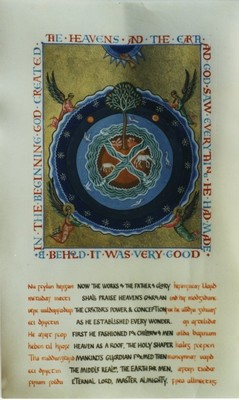
I was going through some of my old Latin stuff on file in my bedroom before I took my afternoon nap (rather later than usual), you know my translations of scripture (the complete Book of Jonah, some Gospel pericopes), bits of St Leo's Tomus ad Flavianum, odd bits of Virgil, and best of all some of my work on St Bede - all redolent of a time when my mind was more active. I came across my translation of the account of St Caedmon, who was a herdsman attached to the double monastery of Whitby during the abbacy of St Hilda. On the evening of a certain festival, as was the custom he went to dinner with the monks to celebrate, and a harp was passed to him. Now being innocent of the art of music he retired to his bed where he was visited by an angel who besought him to sing something. The passage goes:

Quo accepto responso, statim ipse coepit cantare in laudem Dei Conditoris versus quos numquam audierat, quorum iste est sensus: ''Nunc laudare debemus auctorem regni caelestis, potentiam Creatoris et consilium illius, facta Patris gloriae: quomodo ille, cum sit aeternus Deus, omnium miraculorum auctor extitit, qui primo filiis hominum caelum pro culmine tecti, dehinc terram Custos humani generis omnipotens creavit.'' Hic est sensus, non autem ordo ipse verborum, quae dormiens ille canebat; neque enim possunt carmina, quamvis optime conposita, ex alia in aliam linguam ad verbum sine detrimento sui decoris ac dignitatis transferri. Exsurgens autem a somno, cuncta quae dormiens cantaverat memoriter retenuit, et eis mox plura in eundem modum verba Deo digni carminis adiunxit.

When he heard this reply, he immediately began to sing in praise of God the Creator verses which he had never heard, of which this is the sense: ''Now it behoves us to praise the maker of the heavenly kingdom, the power of the Creator and his counsel, the things made of the Father of glory: how he, since he is the eternal God, stands out as the author of all miracles, who first, as the almighty Guardian of the human race, created for the sons of Men the heavens for a roof, and then the earth.'' This is the sense, not however the order of the words themselves, which he sang while sleeping; for neither are songs able, however well they are composed, to be translated literally from one language to another without loss of its decorum and dignity. But arising from sleep, he retained the memory of all that he sung sleeping, and soon added more words to the songs in the same manner, fitting for God.

He paints a very moving picture of God, very typical of St Bede, whose piety and learning were surpassed by none in his life. The Old English staves, of which St Bede gives a Latin translation, exist in an Old Northumbrian edition of the Historia Ecclesiastica commissioned by godly King Alfred for the edification of his people. The song was written in the alliterative metre, beloved of Blessed Ronald Tolkien, which is produced here:

Nu sculon herigean heofonrices weard, meotodes meahte and his modgeþanc, weorc wuldorfæder, swa he wundra gehwæs, ece drihten, or onstealde.
He ærest sceop eorðan bearnum heofon to hrofe, halig scyppend; þa middangeard moncynnes weard, ece drihten, æfter teode firum foldan, frea ælmihtig.

There are some interesting syntax and forms here; the cognate wuldor in ''glory-father,'' used as a kennings for God throughout much Old English poetry, and the constant repetition and pattern of ideas, inherent to the genius of alliterative verse. Most obvious of all, naturally, the form middangeard, the ''Middle-earth,'' which to the Saxons meant the lands of men between the Seas, or not seldom between Heaven and Hell (see the poem Crist by Cynewulf). The significance of the Old English translation of St Caedmon's Hymn cannot be underestimated. According to C.L Wrenn, writing for The Anglo-Saxon Anthology:

If this poet was, in fact, the very first to apply the Germanic heroic poetic discipline of vocabulary, style, and general technique to Christian story and Christian edification, then, indeed, the Hymn must be regarded (as it must have been at the time of its original recitation) as a great document of poetic revolution in early Anglo-Saxon England. Whoever first applied pagan traditional poetic discipline to Christian matter set the whole tone and method of subsequent Anglo-Saxon poetry. He preserved for Christian art the great verbal inheritance of Germanic culture.

How wonderful. This was Tolkien's life work! It is interesting that he established such an ecclesiastical connexion between the Old English tradition and his own legendarium, dedicated to England (not Britain), and mediated by pious works. It is the foundation, and subsequent ethos, of the work that is Christian, not trite things such as Gandalf's return from death seen as a type of the Lamb of God sent to slaughter, though that too is measurable. It's what distinguishes Tolkien from lesser authors.

The patrimony of God...

''I consider a translation of the Rule of St Benedict a very necessary thing. For it does not matter by which language someone is drawn to the faith, so long as in the end they come to God. So let those who only speak English observe it with no excuse! I beg all my successors in the name of our Lord to ensure that the observance of this holy Rule is increased by Christ's grace throughout our land, and many thereby be brought to spiritual perfection.

''Let no man diminish the patrimony of God and so undermine the fire of holy religion as happened in the past when kings had little fear of God. Let us heed the warning and pray earnestly that the old state of affairs never returns. Let no abbot or abbess give away church lands for money or flattery. For they are set as God's shepherds and trustees. May the possessions granted to the Church remain in perpetuity, and may anyone who subverts this languish in the pains of hell!''
St Ethelwold of Winchester.

Thursday, 20 December 2012

Rage...


Quentin Crisp once said that: ''Whenever people read in the papers that someone has purchased a machine-gun and mowed down a whole neighbourhood, they invariably say, 'I wonder what brought that on.'...To me the motive is self-evident. Mass-murderers are simply people who have had ENOUGH.''

Quite. People go on about perspective all the time, you know that hackneyed line: ''there's always someone worse off than you.'' Only ignorant people say that. Perspective has nothing to do with personal problems. Opprobrium, trouble at work, making enemies of all the wrong people (senior management, priests, family, etc), constant anger, cutting off your nose to spite your face, money trouble, depression, trouble with family, having a tendency to always speak your mind, to whomever indiscriminately; take your pick! In the context of all this the very mention of ''perspective'' makes unexpressed rage take the mastery! I don't honestly care about starving people in the back of beyond, whom I've never met, when everyday I wake up I ask myself whether it's worth getting out of bed. A few weeks ago I was in the warehouse at work and an in-store demonstrator was there. This is an incredibly ignorant woman who, every time she comes to the office to sign in, always has to ask for help to fill out the perfectly self-explanatory visitor's book. Anyway, she was looking for Flora Cuisine in the ambient section, which tells me she doesn't know the first thing about what she is trying to sell, I shewed her to the chiller, and went back upstairs. Later, when I went down to recycle some paper, she commented to another colleague (in my presence), ''well, at least someone's happy!''  Maybe she saw the look on my face, my unironed clothes or unkempt hair; who knows? Have you ever wished someone dead, and meant it? I have, and do. We're all put to the test at some point. What worries me is that my wishing is not inspired by adrenalin but cold contempt. The very sight of at least one woman is enough. She was here yesterday, when I came home from work, so I went to bed just to shut out her noise. Waking was no better, though fortunately she was gone by then.

Maybe people don't realise that it's silly things that tip the scale; a look, a stupid comment, you run out of toothpaste or milk for your tea, and that's it. You bring out your revenge list, walk down to the garden shed, pick up the sledge hammer, and off you go. Or you can't face going outside, being exposed to the common light of day and peoples' scorn, and you just go into the kitchen and cut your wrists with the steak knife.

Tuesday, 18 December 2012

Breathing...


Having been depressed for many months many of my books have become damaged for, having a mind to read something in them, my mind wanders onto some other idea, or not seldom nothing at all, and I give up. Eventually the book ends up on the floor, opened on that page wherein I thought to read something wonderful, buried beneath a mountain of discarded papers, clothes, tissues, even empty food packets, and my room becomes such a state that movement itself becomes impeded. For somebody usually very meticulous about cleanliness and with an innate love of books, you must understand how distressing this is. I was admonished against this treatment of my books last week by a friend of mine, himself a bibliophile, who said that to leave books thus is one of the worst things you can do to them. Of course I have bookmarks in plenty but the idea is that sooner or later I will return to the book, open up and pick up where I left off, in exactly the same state of mind and disposition, as though the day, week or month since last I set mine eyes to the words had never happened. It never works like this, or seldom does anyway.

On the way to work this morning I was reminded of a passage in Aldarion and Erendis, a sad story (indeed the only story) which comes down to us from Númenor. I don't know why but it reminded me of something faintly comforting, you know like a familiar smell, something to quicken one's sense of reflection and piety (you'd be surprised how often one's olfactory perception helps in this way); not exactly a déjà vu, but something reminiscent. I had to rummage for my ''rough'' copy (I am not silly enough to leave first editions lying around), but found it without much difficulty, though not in exactly the condition I left it. The passage goes:

''Riding one day in the forests of the Westlands he saw a woman, whose dark hair flowed in the wind, and about her was a green cloak clasped at the throat with a bright jewel; and he took her for one of the Eldar, who came at times to those parts of the Island. But she approached, and he knew her for Erendis, and saw that the jewel was the one that he had given her; then suddenly he knew in himself the love that he bore her, and he felt the emptiness of his days.'' J.R.R Tolkien, Unfinished Tales of Númenor and Middle-earth.

Coming back to what we said earlier about sense, can you not feel yourself standing there? Those woods must have been wonderful, especially at a time of Autumn. Imagine, it has been raining (all seasons in Númenor at that time were ever apt to the needs and liking of men), you are alone, you can feel the clemency of the Númenórean weather on your skin, a wind comes out of the West bearing a fragrance of Avallonë and causing the leaves of the trees to rustle, a sound which calls to mind the angelic chorus and the creative activity of the Holy Ghost, you look down to the Sea, the direction of all godliness, and you breathe deep and know in yourself that you are under God's protection, that your Sovereign is pious, that you are of a noble people. It speaks volumes to me and it reminds me of what Treebeard says in The Lord of the Rings about breathing, that he used to go up into the mountains and just breathe; or Sam's first experience of Ithilien. Of the wind Tolkien says:

''And when the wind was in the west, it seemed to many that it was filled with a fragrance, fleeting but sweet, heart-stirring, as of flowers that bloom for ever in undying meads and have no names on mortal shores.'' (Akallabêth).

That's not to mention the other side of the aforesaid passage - Aldarion's love for Erendis (oh, don't worry; that soon turned to hatred, anyway), and whatever you can see in that. I haven't quite got around to it yet as my mind is still full of breathing. What I found most interesting about Erendis in this scene was the combination of loneliness and colour, everything is grey-green (it is, though Tolkien does not say so, Autumn), and she seemed almost a ghostly figure passing from one tree to the next, being quickened only by the approach of the King's Heir of Númenor, though she turns to flight.

Sensory perception in Tolkien would make a good (albeit difficult) essay for me. We have seen how breathing the air of Númenor can inspire piety, what about listening? We'll think about that next time.

Art: Ted Nasmith. When the Númenóreans looked westward in the days of the domination of the Dark Power they were greeted not with a fair wind but descried instead great clowds, shaped as it were in the likeness of eagles, and the sunset was darkened for they loomed up, threatening, in token of great wrath, and some bore lightning beneath their wings, and thunder echoed between the sky and the sea; and men said: ''Behold the Eagles of the Lords of the West! The Eagles of Manwë are come upon Númenor!'' And they were filled with dread.

Sunday, 16 December 2012

Homophobia...


There's a lot of hysteria among Roman Catholics about Mr Cameron's ideas about the exclusion of gay people from marriage, and what he wants to do about it. I personally couldn't care less; I am a confirmed bachelor in both the Victorian euphemistic sense and any other sense you like - I'm not remotely interested in relationships; and besides, it's a purely civil matter. It wouldn't be such a problem if Roman Catholics weren't so clearly homophobic, even if their church tells them to approach homosexuals with understanding and compassion. In my experience they either let on they don't know or they shun you altogether, in the Pauline spirit of ''expel the wicked from among you.'' Quite different if you're a priest of the London Oratory, of course, or you write books about Liturgy.

The Catechism of the Catholic Church says: ''Every sign of unjust discrimination in their [homosexuals'] regard should be avoided.'' Very well. I will not belabour the obvious discrepancy between this attitude and the one enunciated by St Paul, the Fathers and the Scholastics, who place sodomites among the basest of persons, but unfortunately anything the modern Roman church says about the subject, whether condemning homosexual acts, or repeated homosexual acts which lead to homosexual lifestyles, is tainted with fear and abhorrence, which has its uttermost source in the Devil, not God. Is this toleration? If so it has come in a form that is slightly insulting. You cannot have the unity of faith, acceptance, and a sacramental life on the one hand, and the stigma of going to church every Sunday and being greeted with the ''Oh, God, you're one of those'' look, on the other. ''You cannot sire or bear children, that part of you is crooked, an evil fruit of the Fall; don't be surprised if we don't include you in our extra-ecclesial activities.'' So all the official doctrine in the world makes almost no difference at all; it is the result of popular opinion, a stinking red herring. Thick mick priest is a homophobe, had his share in picking on the weak kid at school, and grew up with this attitude, mistaking it for orthodoxy. I have myself been on the receiving end of this, and I have known Roman Catholic parents to encourage homophobia in their children. I grew up in a homophobic house, where words like ''poof,'' ''pansy'' and ''faggot'' were used without much thought.

Being a compendium of church doctrines one can't expect the catechism to go into any great detail about homosexuality, but everything it says is rather noncommittal. Perhaps this is their idea of trying to fudge over the old ideas under the false ''hermeneutic of continuity,'' or fear of being accused of wanton bigotry without reason on the other, who knows? One Roman priest said to me once that he thought homosexuality didn't exist, and that homosexual tendencies were a temptation to sin rather than an ontological reality in the person. This is, of course, a factual statement about the reality of homosexuality in the human makeup, there is evidence bearing on it, so this man's personal opinion on the matter is completely irrelevant. I daresay that this homophobic individual would be one to support such unscientific articles as this one, begotten of hatred and ignorance.

No, given everything I've just said, it's hardly surprising that Roman Catholics are eaten up with fear and paranoia about Mr Cameron's views, is it?

Thursday, 13 December 2012

Reigning from on high...


''She has removed the royal Council, composed of the nobility of England, and has filled it with obscure men, being heretics; oppressed the followers of the Catholic faith; instituted false preachers and ministers of impiety; abolished the sacrifice of the mass, prayers, fasts, choice of meats, celibacy, and Catholic ceremonies; and has ordered that books of manifestly heretical content be propounded to the whole realm and that impious rites and institutions after the rule of Calvin, entertained and observed by herself, be also observed by her subjects.'' Pius V, Regnans in Excelsis, 25th February 1570.

So much for Anglican Patrimony; ''heretics,'' ''ministers of impiety,'' and, most sweeping of all, ''impious rites.'' What does Anglicanorum Coetibus say about the Anglican tradition? Oh yes, ''a precious gift nourishing the faith...and as a treasure to be shared.''

I found the woodcut of the pope in Google Images. Estote Proditores, ''go and be traitors to your King for daring to oppose the false religion we imposed on you for centuries.'' Succinctly spells out the good of the papacy, doesn't it?

So, jump...ok, how high?


The pope is now using Twitter. Isn't that the greatest news since the Angel of the Lord announced the birth of the Saviour to the shepherds in the deeps of time? It's so wonderful, so critical, I am literally on the edge of my seat awaiting the next tweet! Oh blast, I've just remembered that I deleted my Twitter account so for my penance I'll take a few cold showers, recite some novena prayers, and pray to Our Lady, Queen of Social Networking (in the vain hope that her attention isn't elsewhere, you know, battling devils and shagging priests), that my share in the superabundance of graces no doubt impeded by my objection to such social networking sites doesn't impact on the state of my soul on the Day of Judgement. We can't have everything. Sigh.

Dear God! Anyone who has greeted this non-event with any kind of Ultramontane impiety ought to be shot. Roman Catholics say that they do not worship the pope, and this may be written in their doctrine, but their actions say otherwise. It's as if Our Lord has said, ''don't read the Scriptures, listen to my pope!''

The fate of sycophants in the Divine Comedy by Botticelli, doomed to forever wade through their own shit. This may have been an early Renaissance play on the term ''brown noser,'' you never know.

Wednesday, 12 December 2012

The Hobbit movies...


The first part of the new Peter Jackson film trilogy loosely based on J.R.R Tolkien's great book The Hobbit premieres tomorrow in cinemas throughout the land. Unlike 11 years ago when I first saw The Lord of the Rings at my local Cineworld I will not be going to see any of these new films. Jackson eviscerated The Lord of the Rings by turning it into an action film for an audience of 15-25 year olds, and it seems that these new films will be no different. The chasm between the beauty and seriousness of the work, and what it has become, has gone too far for me. There is only one solution for me now, and that is to turn my head away.